Deck Shade Sail Installation Cost NZ: 2026 Price Guide
Deck Shade Sail Installation Cost NZ: A Comprehensive Planning & Financial Guide
Installing a shade sail over a outdoor deck is one of the most versatile ways for New Zealand homeowners to create comfortable, UV-protected outdoor living spaces. Given New Zealand’s high ultraviolet radiation levels, intense summer heat, and localized wind pressures, a properly tensioned fabric canopy provides reliable shade without permanently blocking sightlines or natural airflow. Unlike solid timber or polycarbonate roof structures, shade sails offer an adaptable architectural element that can be removed during winter months to maximize natural daylight inside adjacent living rooms.
Determining the true financial commitment requires evaluating more than just retail fabric tags. Calculating the deck shade sail installation cost NZ property owners navigate involves analyzing fabric grades (permeable shade cloth vs. waterproof PVC/acrylic), structural support posts (galvanized steel vs. heavy timber), concrete footing excavation below ground level, building code requirements, and local trade fitting fees. This guide breaks down baseline costs across New Zealand, compares structural sail categories, presents practical installation scenarios, outlines budgeting frameworks, and details long-term maintenance practices.
Overview of Deck Shade Sail Installation Cost NZ

Evaluating the deck shade sail installation cost NZ market reveals a wide price range depending on whether the project involves a basic self-installed pre-made canopy or a custom-engineered, multi-post architectural sail.
Self-installed DIY pre-made sail kits start between $100 and $450 NZD for fabric and basic hardware. Small to mid-sized custom-manufactured sails fitted to existing building fascia boards generally range from $1,500 to $3,500 NZD. Turnkey professional installations requiring heavy-walled galvanized steel posts, deep concrete footings, high-tensile marine-grade hardware, and custom-cut commercial shade cloth typically cost between $4,000 and $8,500+ NZD.
+-----------------------------------------------------------------+
|               NZ INSTALLED COST RANGE (TOTAL PROJECT)           |
|                         $150.00 - $8,500.00+ NZD                |
+-----------------------------------------------------------------+
| [= DIY Kit: $150-$600 =] [= Custom Wall-Mount: $1,500-$3,500 =] [= Pro Multi-Post: $4,000-$8,500+ =] |
+-----------------------------------------------------------------+
Core Concepts and Mechanical Forces
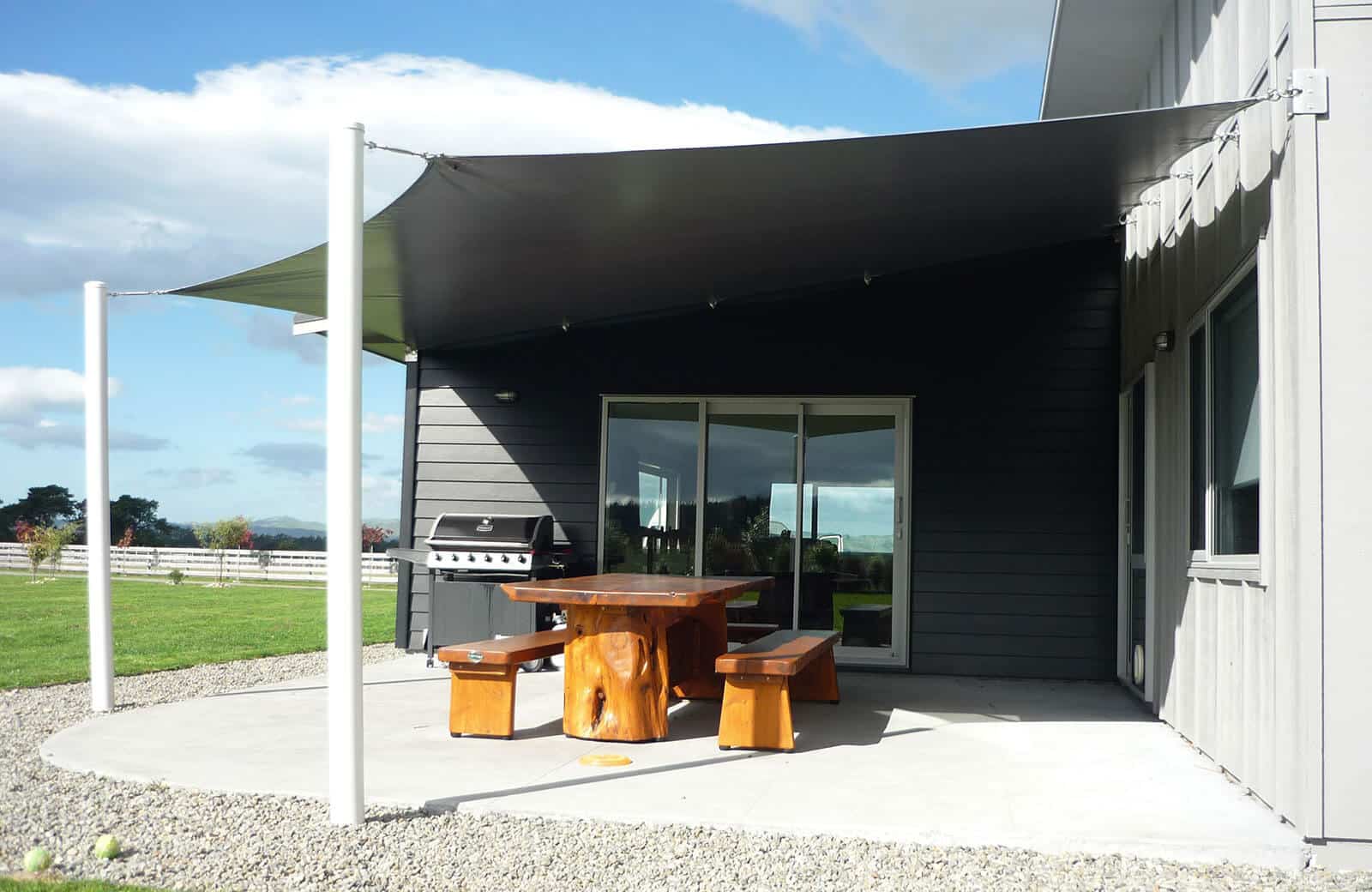
A shade sail is a tensioned membrane canopy secured between multiple elevated attachment points (posts or structural building fixings). When tensioned correctly using stainless steel turnbuckles, the sail forms a hyperbolic paraboloid shape (a twisted three-dimensional curve with alternating high and low points). This three-dimensional shape prevents fabric flap, sheds wind pressure, and directs water runoff on waterproof models.
Primary Cost Drivers in the New Zealand Market
-
Fabric Composition & Permeability: High-Density Polyethylene (HDPE) knitted shade cloth allows air and micro-droplets to pass through, reducing wind load demands on support posts. Waterproof architectural PVC or coated polyester traps wind and water, requiring significantly heavier structural posts, larger concrete footings, and higher engineering inputs.
-
Support Posts & Concrete Footings: Existing house framing can support some attachment points, but ground-mounted posts require heavy-gauge galvanized steel tubing (typically 100mm to 150mm diameter) set into deep concrete piers (up to 1.2 meters deep), adding material and excavation costs.
-
Hardware & Fastener Grade: Marine-grade Grade 316 stainless steel turnbuckles, D-shackles, eye pads, and perimeter wire cables resist coastal salt air corrosion but cost more than basic galvanized hardware.
-
Wind Zone Engineering (NZS 3604): Properties located in High or Very High wind zones (such as Wellington, coastal Taranaki, or hill-ridge sites) require thicker structural post walls, larger concrete footing volumes, and heavy-duty perimeter webbing.
Key Product Categories and Structural Options
Shade sail installations across New Zealand are grouped into distinct categories based on fabric construction, structural mounting types, and custom manufacturing levels.
| Category / Type | Fabric & Hardware Description | Common Use Case | Relative Cost & Labor Level (NZD) |
| Pre-Made DIY Shade Kit | Standard-sized knitted HDPE shade cloth (200–280 gsm); retail hardware kits. | Compact suburban decks, temporary rental shading, budget spaces. | Lowest Cost ($150–$600 total) / DIY Assembly |
| Custom Permeable Shade Sail | Commercial-grade HDPE shade cloth (320–400+ gsm); custom-cut to exact deck dimensions. | Long-term residential decks, high-sun entertaining areas. | Mid-Range Cost ($1,500–$4,500 installed) / Pro Trade |
| Waterproof Architectural Sail | Polyurethane-coated polyester or heavy PVC membrane; fully water-impermeable. | Outdoor dining spaces requiring year-round rain protection. | High Cost ($3,500–$7,500+ installed) / Pro Engineering |
| Multi-Sail Overlapping Array | Two or more layered triangular or hyperbolic sails set at varying heights. | Broad architectural decks, complex residential floor plans. | Highest Cost ($4,500–$9,500+ installed) / Pro Trade |
| Retractable Shade Sail | Track-guided or wire-slid shade canopy operated manually or via pull ropes. | Flexible sun exposure control, seasonal deck shading. | Premium Feature ($3,000–$6,500+ installed) |
Choosing Between Categories
Selecting a shade sail configuration requires balancing weather performance against site exposure. Permeable HDPE shade cloth represents the benchmark choice for most New Zealand home decks. It blocks 90% to 98% of harmful UV rays while allowing hot air to escape upward and wind to filter through harmlessly, preventing extreme uplift forces on building fascia boards. Waterproof sails provide reliable rain shelter but demand heavy-duty structural posts and steep installation slopes (minimum 20 degrees) to prevent water pooling.
Practical Installation Scenarios Across New Zealand Properties
Site access, structural wall substrates, wind exposures, and foundation soils shape total installation costs across New Zealand regions.
Scenario A: Suburban Deck Attachments in Auckland (4m x 4m)
Installing a custom 4×4-meter permeable HDPE shade sail over a low-level rear deck, attaching to two house wall points and two new ground posts.
-
Components & Materials: Commercial 340 gsm shade cloth, 2 galvabond steel support posts (100mm diameter, powder-coated), Grade 316 stainless turnbuckles and eye plates, concrete footing pads.
-
Process Steps:
-
Inspect house wall framing to locate solid timber top plates or studs behind weatherboards.
-
Dig post holes 1.0 meter deep into firm clay subsoil; set steel posts in concrete piers.
-
Mount structural stainless eye plates to house wall framing using heavy timber lag screws.
-
Attach sail corners using Grade 316 stainless steel turnbuckles; tension evenly until the sail forms a rigid hyperbolic curve.
-
-
Relevance: Demonstrates a common residential project combining house wall anchor points with ground posts, keeping total installed costs between $2,800 and $4,200 NZD.
Scenario B: High-Wind Coastal Build in Wellington (5m x 4m)
Constructing a heavy-duty custom permeable sail canopy on a hillside deck exposed to severe coastal wind gusts.
-
Components & Materials: Monofilament heavy-duty shade cloth, 2 schedule-40 heavy-walled steel posts (125mm diameter), stainless steel perimeter wire rope sewn into sail edges, extra-large stainless turnbuckles.
-
Process Steps:
-
Obtain structural engineering sign-off for post wall thicknesses and concrete pier volumes.
-
Core-drill deck timber boards and excavate post piers 1.2 meters deep into rock/clay substrate.
-
Set heavy-gauge steel posts in reinforced high-strength concrete.
-
Tension stainless perimeter wire cable through corners to distribute high wind loads evenly across support hardware.
-
-
Relevance: Highlights high-wind structural requirements where heavy posts, perimeter cable reinforcement, and deep footings set total costs between $4,500 and $7,200 NZD.
Scenario C: Waterproof Sail Installation in Christchurch (5m x 5m)
Fitting a 5×5-meter waterproof PVC shade sail over an entertaining deck to provide year-round rain and sun protection.
-
Components & Materials: Waterproof PVC-coated polyester fabric, 4 independent heavy steel posts, high-torque turnbuckles, subterranean concrete piers.
-
Process Steps:
-
Calculate minimum 20-degree pitch to ensure rainwater runs off rapidly without pooling.
-
Excavate 4 deep concrete post footings to withstand heavy dynamic wind and water loads.
-
Erect posts with alternating high and low attachment heights to establish a steep hyperbolic angle.
-
Tension waterproof fabric using heavy-duty rigging screws.
-
-
Relevance: Illustrates waterproof applications where steep pitch requirements, heavy fabric loads, and independent structural posts push total costs to $5,500 – $8,500+ NZD.
Comparative Scenario Analysis
Standard residential projects utilizing existing house framing connections keep footing expenses low. High-wind coastal builds demand heavy steel post wall thicknesses and deep concrete foundation piers to resist structural uplift forces. Waterproof sail installations represent the highest cost tier because water-impermeable fabrics generate extreme dynamic loads, requiring steep mounting angles and independent heavy support columns.
Planning, Cost, and Resource Allocation
Proper financial management requires itemizing fabric manufacturing, structural steel posts, concrete excavation, marine hardware, and trade fitting fees. The sample budget table below details typical expenses for a 20 $m^2$ custom permeable shade sail installation in New Zealand.
| Category | Estimated Cost (20 m2 Custom Sail NZD) | Explanation | Optimization Tips |
| Custom Shade Sail Fabric | $900 – $1,800 | 340+ gsm HDPE shade cloth, stainless perimeter rings, reinforced webbing. | Choose standard color options (e.g., Charcoal, Sand) to avoid custom dye fees. |
| Steel Support Posts (x2) | $800 – $1,800 | 100mm–125mm galvanized steel posts, powder-coated. | Anchor to existing solid house wall framing where possible to reduce post needs. |
| Foundations & Digging | $500 – $1,200 | Post hole excavation (1.0m deep), concrete bags, site prep. | Clear deck board access yourself before trade installation crews arrive. |
| Hardware & Fasteners | $250 – $600 | Grade 316 stainless turnbuckles, D-shackles, eye plates, wire rope. | Use high-grade marine hardware to prevent rust stains on deck timber. |
| Professional Trade Labor | $1,200 – $2,500 | Professional fitting, post setting, tensioning, structural leveling. | Combine sail installation with other outdoor deck work for combined labor rates. |
Note: Figures above are estimates in New Zealand Dollars (NZD) including GST based on national market averages. Actual contractor quotes vary based on site access, soil conditions, wind classifications, and custom sail dimensions.
Strategies, Attachment Options, and Support Systems
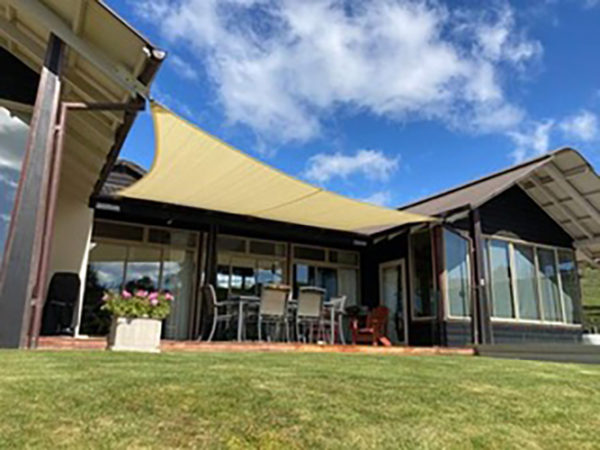
Selecting appropriate hardware grade, attachment points, and post foundations impacts long-term canopy tightness and structural durability.
+-----------------------------------------------------------------+
|                    ATTACHMENT SYSTEM COMPARISON                 |
+-----------------------------------+-----------------------------+
|    HOUSE WALL BRACKET MOUNTING    |     INDEPENDENT STEEL POSTS |
|  [+] Lower total installation cost| [+] Full freedom of placement|
|  [+] Uses existing home framing   | [+] Heavy load-bearing cap  |
|  [-] Risk of wall framing damage  | [-] Requires deep footings  |
+-----------------------------------+-----------------------------+
1. Wall Ledger and Stud Mount Brackets
Mounting stainless steel eye plates directly to internal house timber studs or top plates through exterior cladding.
-
Advantages: Eliminates the cost of extra ground-mounted steel posts; keeps deck floor areas clear of vertical obstacles.
-
Disadvantages: Transfers sail wind loads directly to building framing; requires careful flashing to prevent wall leaks.
2. Fascia Mount Brackets
Specialized structural steel brackets that wrap around timber fascia boards to anchor directly into internal rafter tails.
-
Advantages: Elevates sail height without erecting high ground posts; preserves clear walk-through clearance under eaves.
-
Disadvantages: Cannot be bolted into raw fascia timber alone; requires solid structural blocking behind the fascia.
3. Galvanized and Powder-Coated Steel Posts
Heavy-walled circular or square steel tubing embedded deep into concrete pier footings.
-
Advantages: High structural load capacity; allows placement anywhere around deck perimeters; handles wide sail spans.
-
Disadvantages: Requires deep ground excavation and concrete curing wait times.
4. Grade 316 Marine Stainless Steel Hardware
Rigging screws, turnbuckles, D-shackles, and perimeter wire cables manufactured from marine-grade stainless steel.
-
Advantages: High resistance to coastal salt corrosion; high tension capacity; prevents rust streaking down fabric and timber.
-
Disadvantages: Higher component purchase price than zinc-plated hardware.
Safety Hazards, Structural Risks, and Common Pitfalls
Failing to account for wind uplift, water pooling, or wall fixing strength can cause structural damage or fabric failure.
Structural Post Displacement in Soft Soil
-
The Issue: Support posts leaning inward over time, causing the shade sail to sag and flap in wind.
-
Why It Happens: Digging shallow footing holes or pouring undersized concrete piers in soft topsoil or uncompacted backfill.
-
Prevention: Excavate post holes to a minimum depth of 900mm to 1200mm (or deeper in loose soil) as specified by structural load calculations.
Water Pooling and Canopy Collapse (Waterproof Sails)
-
The Issue: Heavy rainwater accumulating in the center of a waterproof sail, stretching fabric or snapping hardware.
-
Why It Happens: Installing a waterproof sail flat (less than a 20-degree slope) or failing to tension the fabric properly.
-
Prevention: Maintain a minimum 20-degree pitch on all waterproof sails and create alternating high and low corner points to shed rain.
Fascia Board Damage from Wind Leverage
-
The Issue: Sail attachment points pulling timber fascia boards away from house rafters during windstorms.
-
Why It Happens: Bolting eye plates into thin fascia timber without installing internal structural rafter brackets.
-
Prevention: Always anchor wall fixings into solid internal timber studs, top plates, or rafter tails using engineered brackets.
Flat Sail Flapping and Mechanical Wear
-
The Issue: Fabric snapping, noisy flapping in mild breezes, and frayed corner stitching.
-
Why It Happens: Installing a two-dimensional flat sail where all attachment points are set at the same height.
-
Prevention: Design sails with alternating high and low points (hyperbolic paraboloid shape) to lock fabric under equal multi-directional tension.
Maintenance Routines and Long-Term Care Best Practices
Establishing a regular maintenance routine preserves fabric tension, prevents mold growth, and extends overall canopy service life.
+-----------------------------------------------------------------+
|                   SEASONAL MAINTENANCE CHECKLIST                |
+-----------------------------------------------------------------+
| AUTUMN / PRE-WINTER PREPARATION:                                |
| [ ] Remove Sail: Take down sail for winter storage (if required)|
| [ ] Inspect Hardware: Check turnbuckles & shackles for wear     |
|                                                                 |
| SPRING RE-INSTALLATION & CARE:                                  |
| [ ] Wash Fabric: Clean shade cloth with mild soap & hose        |
| [ ] Re-Tension Sail: Tighten turnbuckles to eliminate sag       |
+-----------------------------------------------------------------+
Ongoing Upkeep Guidelines
-
Re-Tension Turnbuckles Seasonally: Check sail tension every spring and mid-summer. Tighten stainless steel turnbuckles to remove minor fabric stretch and restore a rigid, flap-free shape.
-
Wash Fabric Canopy Annually: Clean shade fabric using warm water, a mild household detergent, and a soft-bristle brush. Avoid high-pressure washers, bleach, or harsh chemical solvents, which can damage UV-protective coatings and thread stitching.
-
Winter Storage (Optional but Recommended): In regions subject to heavy winter rain, snow, or extreme gales, unhook turnbuckles, roll the sail neatly, and store it indoors in a protective storage bag to extend fabric lifespan.
-
Inspect Hardware and Anchor Points: Check wall plates, D-shackles, and post bases annually for signs of timber rot, bolt loosening, or metal fatigue.
Project Documentation and Record Keeping
Maintaining organized project records aids warranty claims, simplifies replacement sail re-ordering, and supports property resale disclosures.
Recommended Record Keeping Binder
Keep a dedicated physical or digital home improvement file containing:
-
Material Receipts & Dimensions: Invoices detailing fabric manufacturer, density (gsm), UV ratings, and precise corner-to-corner measurements.
-
Structural Engineering & Permit Documents: Copy of structural engineering calculations, post footing depths, and council exemption verifications.
-
Manufacturer Warranty Certificates: Printed copies of 5- to 10-year fabric UV degradation warranty certificates.
Sample Project Documentation Logs
LOG ENTRY 1: CUSTOM SAIL PURCHASE & FITTING
- Date: November 12, 2026
- Supplier: NZ Shade Sail Specialists (Invoice #NZ-99412)
- Fabric Specs: 340 gsm Commercial Grade HDPE Shade Cloth (Color: Charcoal)
- Dimensions: 4.2m x 4.2m Hyperbolic Square Canopy
- Post Specs: 2 x 100mm Galvanized Steel Posts set 1.0m deep in concrete

LOG ENTRY 2: SEASONAL MAINTENANCE & TENSIONING
- Date: October 20, 2027
- Service Completed: Spring re-installation and cleaning
- Cleaning Method: Washed with soft brush and mild soapy water
- Hardware Check: Turnbuckles greased and retensioned by 15mm
- Next Service Due: April 2028 (Pre-winter removal & inspection)
Closing Summary
Evaluating the deck shade sail installation cost NZ property owners navigate requires balancing DIY budget options ($150–$600 NZD) against professional custom installations ($1,500 to $8,500+ NZD). By choosing appropriate fabric grades (permeable shade cloth vs. waterproof PVC), anchoring support posts into deep concrete piers, utilizing marine-grade stainless hardware, creating hyperbolic tension shapes, and conducting seasonal maintenance, New Zealand homeowners can create a durable, sun-safe outdoor deck canopy built to withstand local weather conditions for years.
Frequently Asked Questions (FAQ)
What is the average cost to install a shade sail over a deck in New Zealand?
Self-installed DIY pre-made sail kits typically cost between $150 and $600 NZD. Custom-manufactured sails fitted to existing house walls range from $1,500 to $3,500 NZD. Turnkey professional installations requiring heavy galvanized steel posts, deep concrete footings, and commercial-grade shade cloth generally cost between $4,000 and $8,500+ NZD.
Do I need building consent for a shade sail in New Zealand?
In most cases, no. Under Schedule 1 of the New Zealand Building Act, flexible shade sails attached to residential dwellings or freestanding posts up to 50 square meters in area are generally exempt from building consent, provided they meet height-to-boundary rules and standard installation guidelines. However, large structures or those installed close to property boundaries should be verified with your local council.
Should I choose a permeable shade cloth or a waterproof shade sail?
Permeable HDPE shade cloth is the recommended choice for most deck installations. It blocks 90% to 98% of UV rays, lets hot air escape, and allows wind to pass through, reducing structural strain on posts and house walls. Waterproof sails provide rain protection but require heavy-duty posts, steep installation angles (minimum 20 degrees), and deep concrete footings to handle high dynamic wind and water loads.
How long does a quality shade sail last in New Zealand conditions?
A high-quality, commercial-grade shade sail made from UV-stabilized HDPE fabric with Grade 316 stainless steel hardware typically lasts 10 to 15 years in New Zealand. Many manufacturers offer 10-year fabric warranties against UV degradation. Basic DIY retail sails generally last 3 to 5 years.